
Is Lucky7even Legit? Licence, Safety and Player Reviews
Every offshore casino tells you it is safe. That claim is worth exactly as much as your ability to check it, and the checking takes less time than a coffee run. So this page sets out what is actually verifiable about Lucky7even: the company behind the brand, the registration number, the licence, the banking rails, and the Australian law that applies to punters here. It also hands you the method, so you can run the same ten-minute audit on any casino you come across, this one included. Where the evidence is thin, or where sources flatly contradict each other, you will see that said plainly rather than smoothed over.
The short answer
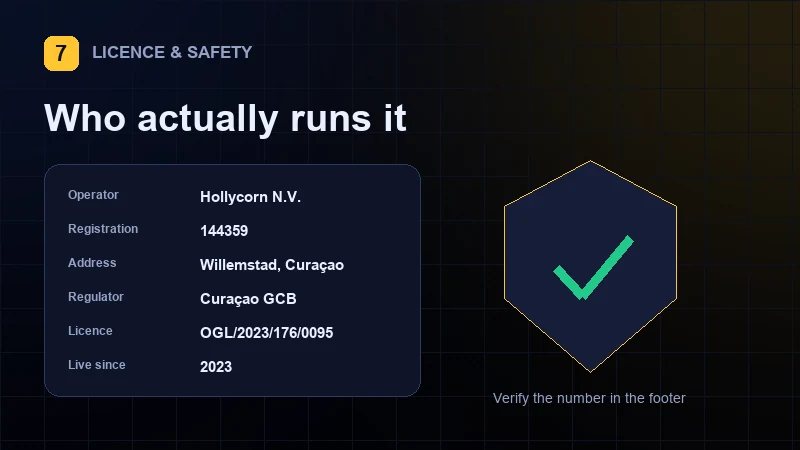
Yes, within limits, and the limits are the interesting part. Lucky7even is a real licensed casino brand rather than a shell site. The operator is Hollycorn N.V., a company registered in Curaçao under number 144359, with a registered address at Scharlooweg 39, Willemstad, Curaçao. The brand holds licence OGL/2023/176/0095, issued directly by the Curaçao Gaming Control Board, and it has traded under that structure since 2023. The lobby carries more than 5,000 titles from over 80 studios, among them Pragmatic Play, Evolution, NetEnt, Playson and BGaming. No disposable site assembles a catalogue like that. Payments run on rails Australians recognise: PayID, BPAY, Visa and Mastercard, Neosurf and crypto.
The gap is that nothing here is Australian-licensed. No offshore casino serving Aussie players holds an Australian online casino licence, because that product cannot be licensed here at all. That one fact shapes the rest of this page. Your protections come from Curaçao, from whichever payment method you chose, and from the records you keep yourself. There is no Australian regulator standing behind your balance. If you only want the licence paperwork in isolation, our licence page covers the certificate details; here we are asking whether the whole picture holds up.
Who is actually behind Lucky7even
The company record
A casino brand is a trading name and nothing more. Regulators licence companies, courts sue companies, and the company in this case is Hollycorn N.V. Registration number 144359 in Curaçao, address Scharlooweg 39 in Willemstad, licence reference OGL/2023/176/0095. Those four data points are what you hold up against the site footer, the terms and conditions, and the certificate seal. Line them up in every place they appear and you are looking at a coherent operation. Should any one of them shift depending on which page you happen to be reading, you have found the story.
The 2023 start date deserves its own line. A brand trading for a couple of years under a directly issued Gaming Control Board licence sits in a different bracket to a site that turned up last quarter on a stock template with no company details anywhere on it. Two years is short next to the European operators, and pretending otherwise would be silly. It is still a track record, and it is one you can check.
Why the operator name matters more than the brand name
Operators run families of brands. One company can sit behind half a dozen casinos with different names, palettes and welcome offers, all of them served by the same back office, the same payments stack and the same compliance team. That is normal in this industry and no red flag by itself. The reason it matters is practical. Your actual experience is set by the operator’s habits rather than by the brand’s marketing: payout speed, the way support handles a stuck withdrawal, how hard bonus terms get enforced. All of that travels with the company. So when you find a casino you like, write down the company name as well as the logo.
What the Curaçao GCB licence actually covers
A licence is a permission plus a list of obligations. Players get burned when they read it as a warranty. Curaçao’s Gaming Control Board authorises the operator, sets rules on game fairness testing, anti-money-laundering controls, responsible gambling minimums and complaint handling, and keeps the power to investigate, fine, suspend or revoke. That is genuine oversight. It also stops well short of a compensation scheme or a payout guarantee, and it reaches nowhere near Australian consumer law.
- Game fairness 30%
- Payment handling 25%
- Dispute channel 20%
- Not covered by AU law 25%
Curaçao GCB next to MGA and UKGC
People reach for Malta or the UK as the comparison. The honest version is that all three regulators sit at different points on one spectrum rather than being different species. Malta and the UK demand heavier capital requirements, stricter segregation of player funds and published enforcement actions, and the UK adds a mandatory alternative dispute resolution route that operators have to fund. Curaçao’s post-2023 regime, where licences come straight from the Gaming Control Board instead of through the old private sub-licence chain, is a real improvement on what came before it. It is also younger, and its enforcement record is correspondingly thin. The table below is the practical version of that difference.
| Regulator | Fund segregation | Independent dispute route | Public enforcement record | Reach over an Australian player’s claim |
|---|---|---|---|---|
| Curaçao Gaming Control Board (Lucky7even) | Required as a licence condition | Complaint to the GCB after the operator’s own process | Short — the direct-licence regime dates from 2023 | Yes, but through the regulator’s process only |
| Malta Gaming Authority | Required, with stricter capital rules | MGA player support unit plus approved ADR bodies | Long, with published sanctions | None — the MGA does not licence this brand |
| UK Gambling Commission | Required, with published fund-protection ratings | Mandatory ADR funded by the operator | Long, with large published fines | None — UK licensing does not extend to Australia |
| ACMA (Australia) | Not applicable | None for offshore casino play | Active, but aimed at operators and access | Regulates the operator’s conduct, not your balance |
What no offshore licence can give you
Whichever foreign regulator is named in the footer, an Australian punter gets no access to the Australian Financial Complaints Authority, no state gambling ombudsman, and no place on the national self-exclusion register that covers locally licensed wagering. Those doors are shut because the product itself cannot be licensed here, and any site suggesting otherwise has not read the Act. What you do get is three things: a documented complaint path, a company with a registered address, and whatever leverage your payment provider gives you. In a genuine dispute the third of those is often the most useful lever you hold.
How to check any casino yourself in ten minutes
Bookmark this part. It works on every casino, this one included, and none of the six checks takes long.
The six checks, in order
- Read the footer properly. Scroll to the bottom of the home page and look for four things: a company name, a registration number, a registered address, a licence reference. A casino footer with no company details in it is the loudest warning sign this industry produces.
- Click the certificate seal. A genuine seal is a link. Clicking it should open a certificate page hosted on the regulator’s own domain, showing the operator name and licence number you just read in the footer. If nothing happens when you click, you have your answer.
- Cross-check the terms and conditions. Open the T&Cs and search for the company name. The entity in the contract you are agreeing to has to be the same entity named in the footer and printed on the certificate.
- Read the withdrawal terms while you still have nothing at stake. Find the daily and monthly cash-out ceilings, the verification triggers, and any maximum-win cap sitting on bonus money. Lucky7even’s own ceiling is A$3,000 a day, and the withdrawal walkthrough works through what that means in practice.
- Run a small test withdrawal. Deposit a modest amount, play a little, then cash out early. One A$50 withdrawal will teach you more than an afternoon of reading reviews. Time it, and note whether verification gets requested and how clearly the request is explained.
- Search for complaints under the operator name. Pair the company name with words like “withdrawal” or “verification”. A brand-name search mostly returns marketing pages. The company name surfaces the pattern across every casino that operator runs, which is what you are actually after.
| Check | Where to look | Red flag if you see this |
|---|---|---|
| Operating company named | Home page footer, T&Cs, privacy policy | No company name anywhere, or three different names across three pages |
| Registration and address | Footer small print | A number with no jurisdiction attached, or an address that is only a PO box reference |
| Licence certificate | Footer seal, linking to the regulator’s own domain | A seal that is a flat image, or one that links to a page on the casino’s own site |
| Withdrawal limits and caps | Terms, banking or bonus policy pages | Limits that are unstated, or a max-win cap buried only in the bonus terms |
| Verification rules | KYC and AML policy | No stated document list, or verification described only as “at our discretion” with nothing else |
| Complaint history | Search the operator name plus “withdrawal” | The same unresolved pattern repeating across several brands from one company |
| Restricted-country list | Terms, geo policy | Your own country listed as restricted while the site still takes your deposit |
A worked example: the operator details that did not check out
Here is the method catching something real. Several third-party review sites describe Lucky7even as run by an operator called “Metlait SRL”, licensed by the Tobique Gaming Commission or under an Anjouan licence. Run checks one and two and that story falls apart. The footer of the operator’s own site names Hollycorn N.V. with registration 144359 and a Curaçao Gaming Control Board licence, and direct checking turns up nothing at all supporting the alternative details. Those pages are almost certainly recycling boilerplate from a write-up of a different brand, with the name swapped and the operator paragraph left where it was.
Take two things from that. Aggregator sites are not primary sources; the operator’s own footer and the regulator’s certificate are. And when a review site disagrees with what the casino publishes about itself, the casino is not automatically at fault, though it is always worth ten seconds of your attention, because from the outside a genuinely dodgy operation produces exactly the same mismatch.
One honest wrinkle on Lucky7even’s own pages is worth flagging. The Australian landing content promotes a welcome package worth up to A$3,000, while some of the surrounding text on the same page still quotes a €2,000 figure left over from an unlocalised template. Sloppy copy rather than a trap, and the A$3,000 structure is the one that applies to an account funded in Australian dollars. Still, it is the sort of inconsistency you want to be in the habit of noticing. Our bonus breakdown works through the four deposits and the wagering maths in full.
Is it legal for Australians to play at Lucky7even?
What the Interactive Gambling Act 2001 actually says
The Interactive Gambling Act 2001 is pointed at operators. It makes it an offence to provide prohibited interactive gambling services, meaning online casino games, pokies and live dealer tables, to people in Australia, and it creates no offence at all for the person playing. There is no fine anywhere in the IGA for an Australian who signs up to an offshore casino and has a punt, and nobody here has been penalised for doing it. People ask this question nervously and rarely get a straight answer, so there it is.
What ACMA actually does
The Australian Communications and Media Authority enforces the Act. Day to day that means investigating complaints about offshore operators, publishing findings, referring operators to overseas regulators and asking internet providers to block domains. Only the last of those is likely to show up in your life, as a site that suddenly will not load on your home connection. An access block targets the operator; it is not enforcement action against you. Our geo restrictions page covers how blocking works and which regions Lucky7even excludes outright.
So the position is awkward but clear. The operator is doing something Australian law prohibits. You are not. And you have no Australian regulator to appeal to if things go wrong. All three of those hold at the same time, which is why a page that offers you only the comfortable part of it is not telling you much.
Your rights in a dispute, and where to complain
Step one: the operator, in writing
Every complaint path starts here, and skipping it makes the steps after it useless. Write to [email protected] rather than opening live chat, because you want a record with timestamps on it. State the account email, the amount, the dates, the method, and what you want to happen. Attach screenshots of the transaction history. Keep it factual and keep it short. Most stuck withdrawals turn out to be a verification problem or a bonus-term problem, and both are usually sorted at this stage once somebody names the actual reason.
Step two: the regulator
When the operator’s own process stalls, or the answer it gives you makes no sense, the escalation route is a complaint to the Curaçao Gaming Control Board. Quote licence OGL/2023/176/0095, the operator name and your full correspondence trail. That mechanism is what the licence buys you, and it is why a licensed casino beats an unlicensed one even when the licence is not a top-tier one.
What a realistic outcome looks like
Set your expectations before you start. A regulator complaint is slow and documentary, usually measured in weeks rather than days, conducted in English by email, with no guarantee you get the result you wanted. It works best on clear-cut facts: a withdrawal approved and then not paid, a term applied that does not appear in the published T&Cs, verification demanded again for documents already accepted. It works poorly on judgement calls, like an accusation of bonus abuse where the terms genuinely allowed the operator’s reading. Separately, if you funded the account by card, your issuer runs its own dispute process on its own timelines, and that lever is worth understanding before the day you need it.
Risk signals worth watching at any offshore casino
Money moving slowly, or only one way
Deposits are instant everywhere; a casino’s real character shows on the way out. Watch for cash-outs that sit in “pending” well past the stated processing window, for a pending period that quietly stretches as the amount grows, or for withdrawals cancelled and pushed back into your balance with no clear reason attached. A single slow payout over a weekend means nothing much. The same thing three times running is a pattern, and the pattern is what you are watching for.
Terms that move
Screenshot the bonus terms on the day you accept an offer. A maximum cash-out cap that materialises after you win, a wagering requirement described one way on the promo page and another way in the T&Cs, a game-weighting rule that shifts mid-playthrough — each of those is worth a formal complaint. Regulators engage with this class of dispute readily, because a dated screenshot settles what an argument cannot.
Verification that never ends
One-time verification at first withdrawal is standard practice, and at Lucky7even it typically lands either at your first cash-out or once cumulative withdrawals reach roughly A$2,000. The operator does not publish an exact threshold, so treat any specific figure you see quoted as an estimate rather than a rule. Repeated re-verification is the abnormal version: documents accepted in March getting rejected in June, or a fresh document type requested every time you clear the previous batch. Get ahead of it by verifying straight after sign-up, while nothing is waiting on it, and read our security overview for how the site handles data in transit.
What Australian players typically raise about casinos in this class
Before the specific cases filed against this brand, the categories of complaint that recur across offshore casinos serving Australia are worth naming, because knowing the shape of a problem tells you what to prepare for. Three dominate. Verification timing is the big one: players deposit, win, and only then meet a document check standing between them and their money, which reads as stalling even when it is routine compliance. Wagering maths comes next. A 40x requirement on the bonus portion means a A$300 bonus carries A$12,000 of turnover, and a player who never ran that number before accepting will feel misled by an offer that was in fact clearly stated. Then there is the daily ceiling. A$3,000 is fine for ordinary play and infuriating on a five-figure win, which then pays out in instalments across several days.
Every one of those is predictable from the published terms, and none of them requires a casino to behave badly. Plenty of complaints in this segment do come down to a player meeting a term they never read. Plenty do not, and the difference is not something you can settle by assuming good faith on either side. Money that never arrives, support that stops replying, an explanation that never gets given: those are operator failures whatever the terms say, and Lucky7even has reviews describing all three. The section below sets out what has actually been filed, how far each account can be trusted, and where the fault plausibly sits.
What players actually complain about
Two bodies of evidence exist for this brand: complaints logged with casino.guru’s dispute service, which publishes the operator’s response alongside its ruling, and reviews posted on Trustpilot. The Trustpilot caveat belongs up front: those pages would not respond to direct checking, so the figures below are reported rather than independently verified, and two of the accounts rest on a single source each.
The cases that reached a dispute service
Three complaints are documented on casino.guru. A player in Ukraine had a free-spin win voided over a maximum bet limit applied during wagering, which they said was never made clear; the service checked the published terms, found the bet cap was in fact stated, and closed the case against the player. A player in Latvia had an account shut with 114 euro withheld, and the operator produced evidence of fraudulent activity, so that closure was accepted as justified. The third reads differently: a player in Canada was advertised a no-deposit bonus, then told a deposit was required before the winnings could be reached.
What the review sites carry
Trustpilot scores the brand 2.9 out of 5 across 159 reviews, 58 per cent of them one-star, on the figures retrieved. Four accounts sit behind that number. A win of roughly $11,000 confiscated in June 2026 on the grounds of a bonus-term breach, the one story that also surfaced independently in a separate search. A $50 deposit that never credited in April 2026, followed by four months without a refund and, by the reviewer’s count, more than a hundred unanswered emails; that came up twice as well. An account deleted in August 2026 immediately after a withdrawal request on a win of about $35, with no reason given. And a refused $1,000 payout the same month. The last two rest on one source apiece, and amounts are as reviewers wrote them on Trustpilot’s Canadian site, so not every figure is in Australian dollars.
Which of these is the operator’s problem
They are not the same kind of failure. A win voided under a term that turns out to be published is on the player, and the dispute service said as much in the case it ruled on. A deposit that never lands and draws no reply for four months is a service failure whatever the terms say, and an account deleted straight after a withdrawal request, with nothing explained, is no bonus clause’s doing. The five-figure confiscation sits between the two: from outside the account nobody can say whether the term was breached.
How to stay out of these stories
- Verify on day one, before there is anything waiting on it.
- Screenshot the bonus terms when you accept an offer, including the maximum bet allowed during wagering. That rule voided a win in one of the cases above.
- Keep the transaction record. A dated bank screenshot turns a non-credited deposit into a case somebody has to answer.
- Know the A$3,000 daily ceiling before you win, not after.
- Run a small test cash-out early, while losing the argument costs you nothing.
The safety basics behind the licence
Beyond the paperwork, a few practical markers are worth confirming. Traffic runs over SSL/TLS, with the site stating 128-bit encryption for data in transit. Support runs on live chat around the clock plus email at [email protected], and that matters more than it sounds, because a casino that is hard to contact is a casino that is hard to complain to. The game catalogue comes from named studios instead of unbranded clones, and titles from Pragmatic Play, Evolution and NetEnt carry their own independent testing regimes, which puts a layer of fairness assurance outside the operator entirely.
Two absences get misreported elsewhere, so state them here. There is no sportsbook: Lucky7even is a casino only, and anyone who turned up for footy markets is on the wrong site. There is also no native app to download. Mobile play is a progressive web app that runs in your browser and pins to your home screen, which our 25-question FAQ walks through. Any site offering you a Lucky7even APK is not the operator, and installing that file would be a genuine security risk.
Sign up and verify your account earlyPayID cash-outs clear in 2-12 hours once verification is doneVerdict: who it suits, and who should walk
Lucky7even is legitimate in the sense that matters: a named operator, a directly issued Curaçao Gaming Control Board licence, a real game catalogue from real studios, working Australian payment rails, and a support channel that answers. It is not legitimate in the sense some players quietly hope for, because no offshore casino is. No Australian licence exists for this product, no Australian ombudsman will take your call, and no compensation scheme sits behind your balance. Play if you like, but do it with the second half of that in view as well as the first.
| In its favour | Against it |
|---|---|
| Named operator with a verifiable registration: Hollycorn N.V., 144359, Curaçao | No Australian licence, and no Australian dispute body to appeal to |
| Licence issued directly by the Curaçao GCB, OGL/2023/176/0095, active since 2023 | Curaçao oversight is lighter and newer than MGA or UKGC oversight |
| PayID and BPAY supported, so no card-decline workarounds needed | A$3,000 daily withdrawal ceiling slows a large win to instalments |
| PayID cash-outs in 2-12 hours, crypto in 1-4 hours | Card withdrawals take 3-5 business days |
| 5,000+ games from 80+ named studios with independent game testing | 40x wagering on the welcome bonus is above the market average |
| 24/7 live chat plus a written email channel for disputes | Verification threshold is not published, so timing is unpredictable |
| Mobile play works in-browser with no download required | No sportsbook and no native app, despite what some listings claim |
It suits punters who play regularly at modest stakes, use PayID or crypto, verify their account on day one, and treat the welcome offer as optional rather than the reason to join. It will frustrate anyone who wants a regulator in their own timezone, expects a five-figure withdrawal to arrive in a single transaction, or is uneasy about holding a balance with a company registered on the other side of the world. If gambling has stopped being entertainment for you, the deposit limits and self-exclusion tools described on our responsible gambling page matter far more than any licence number, and Gambling Help Online answers on 1800 858 858, 24 hours a day. For everything else about the brand, the main Lucky7even review pulls the bonuses, banking and games together in one place.
Updated 3 September 2026
Lucky7even checks out where it counts: Hollycorn N.V. is a named operator with a verifiable Curaçao registration, the GCB licence is issued directly rather than sub-licensed, and the payment rails are the ones Australians actually use. The limits are real though, with a A$3,000 daily cash-out ceiling and no Australian regulator to appeal to if a dispute goes sideways. Verify on day one, keep your own records, and it is a sound place to play.